New Product Launch
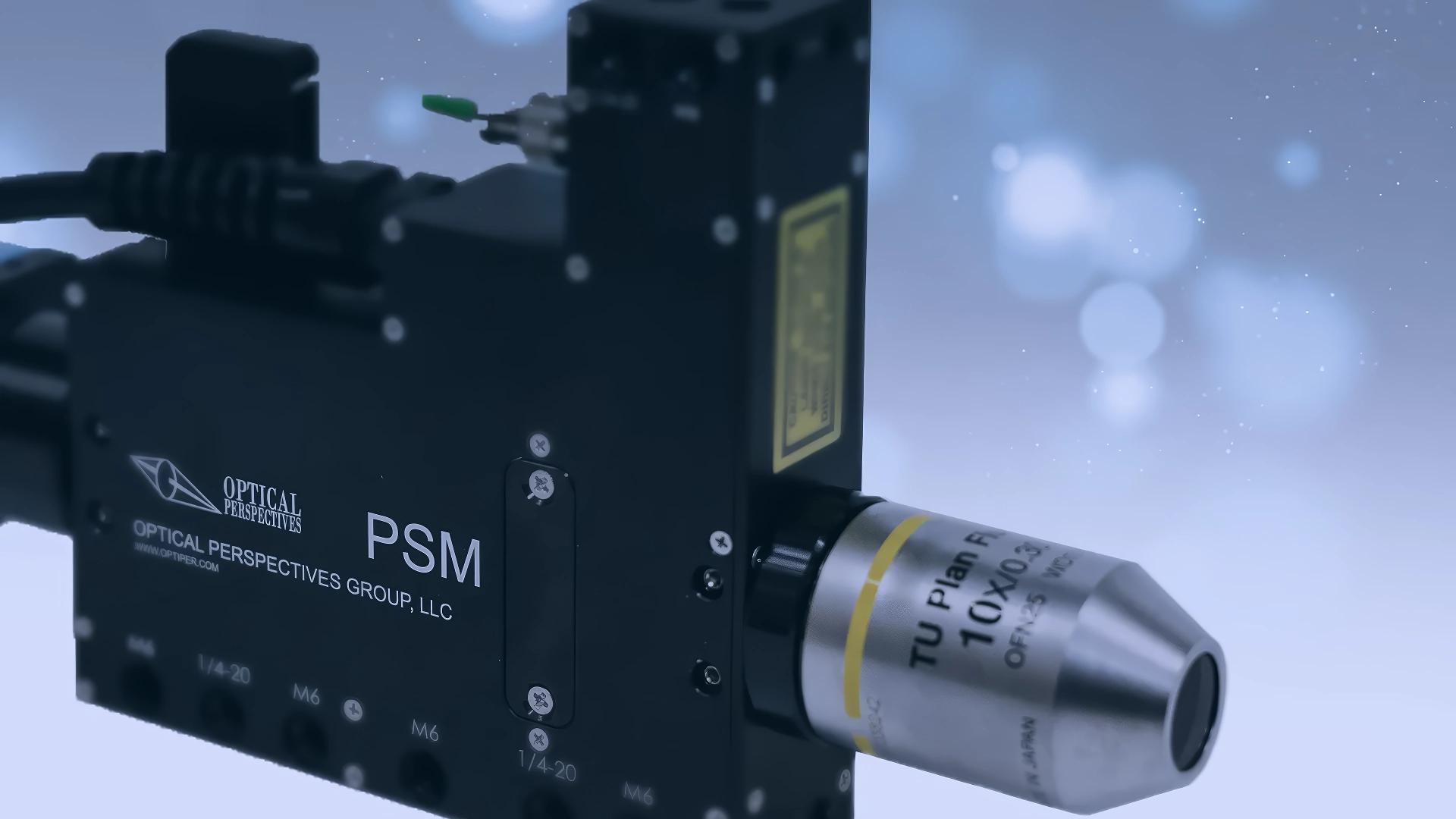
Optical Perspectives Group proudly introduces PSM Align
Revolutionary Python-Based Software for Point Source Microscope
Now Standard on All PSM Units

Author: csadmin

Understanding Point Source Microscopes: Complete Technical Guide for Engineers

If you’re working in optical engineering or precision metrology, you’ve likely encountered situations where traditional alignment tools fall short. Maybe you’re aligning off-axis optical systems, or perhaps you need to reference optical centers to mechanical datums with sub-micron precision. This is where a point source microscope becomes invaluable.

A point source microscope (PSM) is a self-contained optical metrology system that combines a point light source, beam splitter, microscope objective, and digital camera to measure the position of optical surfaces in three degrees of freedom. Unlike interferometers that measure wavefront quality, PSMs specifically excel at determining the exact location of centers of curvature and optical axes relative to mechanical reference points.

How Does a Point Source Microscope Work?

The fundamental principle behind PSM operation is elegant in its simplicity. The device projects a point source of light (typically from a laser diode) through a beam splitter and microscope objective onto an optical surface. When this light hits a curved optical surface at its center of curvature, it reflects directly back through the system.

The reflected light creates a focused spot on the PSM’s digital CCD camera. Advanced software algorithms then calculate the exact position of this spot relative to an electronic reference point, providing real-time feedback in X, Y, and Z coordinates. This immediate positional data allows engineers to make precise adjustments during alignment procedures.

What makes this particularly powerful is the PSM’s ability to switch between point source mode and Köhler illumination. This dual functionality means you can use it as both an alignment tool and a portable microscope for inspecting surface quality or verifying component positioning.

Point Source Microscope vs. Interferometer: Key Differences

Many engineers initially confuse PSMs with interferometers, but these tools serve distinctly different purposes in optical metrology. Understanding when to use each can save significant time and improve measurement accuracy. For a detailed comparison, check out this analysis of PSM vs. interferometer applications.

Interferometers measure wavefront quality and surface figure errors by analyzing interference patterns. They excel at detecting nanometer-scale surface deviations but require stable environments and complex setup procedures. A typical Zygo interferometer setup might take 30-45 minutes for a single measurement.

Point source microscopes, conversely, measure position rather than surface quality. They determine where optical elements are located in space, making them ideal for alignment tasks. Setup typically takes under 5 minutes, and measurements happen in real-time. The PSM system from Optical Perspectives includes Python-based software that provides centroid data output for automated feedback systems.

Consider this practical scenario: You’re aligning a three-mirror anastigmat telescope. An interferometer would tell you if each mirror’s surface meets specifications, but a PSM tells you whether those mirrors are positioned correctly relative to each other and the optical axis.

When Should You Use a Point Source Microscope?

PSMs shine in specific applications where traditional alignment methods struggle. Off-axis optical systems, for instance, pose unique challenges because their optical and mechanical axes don’t coincide. A PSM can establish reference points for each optical element independently, then relate them to the overall system coordinates.

Multi-element lens systems benefit tremendously from PSM alignment. When assembling a complex objective with 12 or more elements, each lens must be centered to within microns of the optical axis. The PSM’s ability to locate each surface’s center of curvature makes this process systematic rather than trial-and-error.

Precision manufacturing environments use PSMs for quality control during assembly. Boeing’s satellite optics division, for example, employs PSMs to verify that each optical component meets positional tolerances before final integration. This catch-as-you-go approach prevents costly rework downstream.

Research laboratories find PSMs particularly valuable for prototyping. When developing new optical configurations, the ability to quickly assess and adjust alignment accelerates the design iteration process. The University of Arizona’s College of Optical Sciences has documented using PSMs to reduce prototype alignment time by up to 70% compared to traditional autocollimator methods.

Common Applications in Optical Alignment and Metrology

The versatility of point source microscopes extends across numerous industries. In semiconductor manufacturing, PSMs align projection optics in photolithography systems where even 100-nanometer misalignments can cause yield losses exceeding $50,000 per hour.

Aerospace companies utilize PSMs for star tracker calibration and satellite optical system assembly. The James Webb Space Telescope team employed similar technology during the alignment of its 18 hexagonal mirror segments, though at a much larger scale.

Medical device manufacturers rely on PSMs when assembling endoscope optics and surgical microscopes. The ability to verify optical alignment without disassembly saves significant time during FDA validation processes.

Even emerging fields like quantum computing require the precision that PSMs provide, where photonic qubits demand optical alignment tolerances measured in fractions of wavelengths.

Technical Specifications That Matter

When evaluating point source microscopes for your application, several specifications directly impact performance. Measurement accuracy typically ranges from 0.1 to 1 micron, depending on the working distance and optical configuration. The PSM’s field of view determines the maximum misalignment it can detect before requiring repositioning.

Working distance flexibility proves crucial for complex optical assemblies. Modern PSMs offer working distances from 10mm to over 200mm, accommodating everything from microscope objectives to telescope mirrors. Some systems include interchangeable objectives to optimize performance for specific distance ranges.

Software capabilities significantly affect usability and integration. Advanced PSM systems provide API access for automated testing, data logging for quality documentation, and real-time graphical feedback for manual alignment. The ability to export centroid data in standard formats enables integration with existing metrology workflows.

Environmental tolerance specifications determine where you can reliably use the PSM. Industrial-grade systems operate accurately in temperature ranges from 15°C to 35°C with vibration isolation requirements similar to standard optical tables.

Frequently Asked Questions

What is the typical accuracy of a point source microscope?

Most commercial PSMs achieve positional accuracy between 0.1 and 1 micron, with repeatability often better than 0.05 microns. The exact accuracy depends on factors including working distance, optical magnification, and environmental stability.

Can a PSM replace an interferometer in my lab?

No, PSMs and interferometers serve complementary roles. PSMs excel at positional measurements and alignment, while interferometers measure surface quality and wavefront errors. Most optical labs benefit from having both tools available.

How much training is required to operate a PSM effectively?

Basic PSM operation typically requires 2-4 hours of training for someone familiar with optical systems. Advanced features like automated alignment routines or custom software integration might require additional instruction from the manufacturer.

What’s the typical cost range for a point source microscope system?

Complete PSM systems range from $25,000 to $150,000 depending on specifications, software capabilities, and included accessories. This represents a fraction of the cost of comparable interferometer systems while offering faster setup and operation.

Making the Investment Decision

Determining whether your facility needs a point source microscope requires analyzing your current alignment challenges and future requirements. If you’re experiencing these situations, a PSM likely offers strong ROI: alignment procedures taking hours instead of minutes, inconsistent results between operators, or difficulty maintaining alignment tolerances in production.

Calculate the potential time savings by documenting current alignment procedures. If technicians spend 20 hours weekly on optical alignment at $75/hour, that’s $78,000 annually in labor alone. A PSM that reduces alignment time by 50% pays for itself within 18 months. For a detailed breakdown, review this ROI analysis for PSM investments.

Consider also the indirect benefits: reduced scrap rates from misaligned assemblies, faster product development cycles, and improved capability to take on complex optical projects. Common alignment mistakes that derail research labs often stem from inadequate metrology tools rather than operator error.

The National Institute of Standards and Technology emphasizes that proper optical metrology tools are essential for maintaining measurement traceability in precision manufacturing. Similarly, the International Society for Optics and Photonics (SPIE) regularly publishes studies demonstrating how advanced alignment tools like PSMs enable next-generation optical systems.

Next Steps for Implementation

Successfully integrating a point source microscope into your workflow requires careful planning. Start by identifying your most challenging alignment tasks and documenting current procedures. This baseline data helps quantify improvements after PSM implementation.

Request demonstrations from PSM manufacturers using your actual components when possible. This hands-on experience reveals how well different systems handle your specific applications. Pay attention to software usability, as this often determines day-to-day satisfaction more than raw specifications.

Prepare your facility by ensuring adequate vibration isolation and temperature control in the PSM operating area. While PSMs tolerate normal laboratory conditions, optimal performance requires attention to environmental factors.

Understanding what a point source microscope is and how it enhances optical alignment capabilities positions your team to tackle increasingly complex optical challenges. Whether you’re aligning precision optics for aerospace applications or developing cutting-edge photonic devices, the PSM provides the accuracy and efficiency modern optical systems demand.

Ready to explore how a point source microscope can transform your optical alignment processes? Contact Optical Perspectives to discuss your specific metrology requirements and schedule a demonstration of our PSM system tailored to your applications.

optical alignment

Optical Alignment for Quantum Computing: Why Precision Matters More Than You Think

Quantum computing companies face a brutal optical alignment challenge. Misalignment in a camera lens blurs your photos. Misalignment in a quantum system destroys qubit coherence and crashes gate fidelity below usable levels.

The problem isn’t just tighter tolerances. It’s that quantum systems are spread across optical tables where every element needs independent adjustment in five axes. No rotation reference. No mechanical constraints. Just laser beams propagating through space and strict requirements for sub-micron positioning accuracy.

Why Standard Methods Fail

Walk into most optics labs, and you’ll see alignment done with index cards following laser beams. For quantum computing, that’s like using a yardstick for nanofabrication.

Autocollimators help, but struggle with the distributed layouts common in quantum setups. They need frequent objective changes and work poorly with anti-reflection coatings. Visual methods can’t provide the quantitative feedback quantum tolerances demand.

The real issue is measurement. You need to know exactly how far from correct alignment you sit, not guess based on beam spots on cards.

What Different Quantum Systems Need

Trapped Ion Systems manipulate individual atoms with laser beams focused to micrometer spots. Each ion is a qubit. You need to hit your target without affecting neighbors spaced micrometers away. Any defocus increases quantum gate error rates. The entire system operates in ultra-high vacuum, so you can’t adjust alignment after sealing the chamber.

Photonic Quantum Processors encode qubits in photon properties like polarization and path. Every beam splitter, waveplate, and mirror needs precise alignment because losses directly degrade qubit fidelity. Interferometric stability requirements reach fractions of a wavelength.

Neutral Atom Arrays trap hundreds of atoms in optical tweezers. Each tweezer requires precise positioning, and manually aligning hundreds of beam paths isn’t practical at scale.

The Bessel Beam Solution

One breakthrough uses Bessel beams as alignment references. Unlike Gaussian beams that diverge, Bessel beams maintain structure over extended distances. They behave like single rays in optical design software.

Combined with an autostigmatic microscope, this technique provides quantitative feedback for systematic alignment. A quantum computing company with no prior experience borrowed a Point Source Microscope and achieved its best alignment performance within a week. The difference was the measurement feedback that their visual methods couldn’t provide.

Alignment Tolerances That Matter

Quantum systems need tighter specs than classical optics. Laser beam pointing stability for trapped ions reaches sub-microradian levels. Photonic interferometric paths need matching to fractions of a wavelength. Temperature drifts invisible to conventional systems cause coherence loss in quantum applications.

These aren’t arbitrary requirements. Quantum effects amplify small imperfections. Miss alignment by microradians and you’re illuminating the wrong atom. Misalign a waveplate by a degree and you get measurable fidelity degradation.

Practical Steps Forward

Design for alignment from the start. Include mechanical datums, fiducial marks, and measurement access in your optomechanical design. Position components where instruments can reach them.

Use measurement-guided alignment, not mechanical positioning. Optical performance depends on optical properties like centers of curvature, not mechanical edges. Align to what matters using tools that measure it directly.

Consider modular approaches. Align subsystems independently before integration. Pre-aligned modules enable faster reconfiguration when experimental requirements change.

Tools That Actually Work

Point Source Microscopes work well for tabletop quantum optics because they’re portable, precise enough for quantum requirements, and versatile across diverse geometries. Electronic reference points eliminate subjective judgment. Quantitative feedback enables systematic convergence to tight tolerances.

The common thread across successful quantum alignment is measurement feedback. You need instruments that measure optical properties directly and provide data precise enough to guide sub-micron adjustments.

The Bottom Line

Quantum computing is moving from labs toward production. Alignment precision directly impacts gate fidelities, coherence times, and system reliability. Budget time for it. Invest in proper measurement tools. Design systems that can actually be aligned to the tolerances your physics demands.

Better alignment translates into better qubits, which enable more complex quantum circuits, which open new applications. That makes alignment more than an assembly problem. It’s a performance enabler.

ROI Analysis: When to Invest in a Point Source Microscope for Your Lab

Capital equipment decisions demand rigorous financial justification. When precision optical alignment challenges consume your lab’s time and budget, determining whether a Point Source Microscope delivers adequate return on investment requires examining multiple cost factors, time savings, and performance improvements.

At $23,950 for a complete system including Python-based PSM Align software, the Point Source Microscope represents a significant investment for most research labs and optical manufacturing facilities. Understanding when this investment pays for itself—and when alternative approaches might prove more cost-effective—helps you make informed metrology equipment decisions.

The Hidden Costs of Inadequate Alignment Tools

Before calculating PSM return on investment, recognize the costs your current alignment methodology imposes on your operations. These expenses often remain hidden in project timelines, labor allocation, and compromised system performance rather than appearing as line items in equipment budgets.

Time Investment Per Alignment Task

Manual alignment using visual inspection or basic mechanical tools requires substantial skilled labor time. A typical multi-element optical assembly might require 8-12 hours of alignment work when using traditional autocollimators or alignment telescopes. Complex systems with off-axis elements, distributed optical paths, or tight tolerance requirements can extend alignment time to multiple days.

Consider your lab’s hourly burden rate for optical engineers—typically $75-150 per hour, including salary, benefits, and overhead. A single multi-day alignment task costs $2,400-$7,200 in labor. If your lab performs even modest volumes of optical alignment work, these labor costs accumulate rapidly.

Component Scrap and Rework

Alignment errors discovered late in the assembly process require component disassembly, cleaning, and realignment. Best-case scenarios involve only time loss. Worst-case scenarios include damaged coatings, contaminated optics, or mishandled components requiring replacement.

The American Society for Quality reports that quality issues typically consume 15-20% of revenue across manufacturing operations. Optical systems face particular vulnerability because alignment errors may not manifest until final system testing, after significant investment in component procurement, fabrication, and initial assembly.

A custom optical assembly with $5,000 in components requires complete disassembly and rework when final testing reveals alignment-induced aberrations. The original alignment labor is lost. Additional labor for disassembly, cleaning, realignment, and retesting doubles the project’s labor cost. If components sustain damage during disassembly, material costs escalate further.

Opportunity Costs

Equipment scheduling delays cascade through project portfolios. When alignment tasks overrun estimates, subsequent projects face delayed starts. Research teams miss publication deadlines. Manufacturing facilities fail delivery commitments.

These opportunity costs are difficult to quantify precisely but significantly impact operations. A research lab that loses priority access to a synchrotron beamline due to alignment delays suffers months of schedule disruption. A contract manufacturer that misses delivery dates faces penalty clauses and damaged customer relationships.

Quantifying PSM Benefits

Point Source Microscope investment delivers measurable returns through reduced alignment time, improved first-pass success rates, and expanded capability to handle complex optical geometries. Calculating these benefits against the $23,950 purchase price reveals when the investment makes financial sense.

Alignment Time Reduction

PSM’s portable, self-contained design with electronic reference points eliminates much of the setup overhead that plagues traditional alignment methods. The instrument operates under normal laboratory lighting without requiring darkened rooms or vibration-isolated environments. Measurements provide immediate quantitative feedback rather than subjective visual assessment.

Real-world implementations demonstrate 3-5x reduction in alignment time for typical optical assemblies. A task requiring 8 hours with traditional autocollimation can be completed in 90-120 minutes with PSM guidance. This time compression delivers immediate, measurable ROI.

Calculate your time savings: If your lab conducts 50 alignment tasks per year, averaging 8 hours each, traditional methods consume 400 hours annually. PSM reduces this to 80-130 hours, saving 270-320 hours of skilled labor. At a $100/hour burden rate, that’s $27,000-$32,000 in annual labor savings—recovering the PSM investment in under one year.

Improved First-Pass Success Rates

Quantitative measurement feedback prevents the trial-and-error iteration that characterizes qualitative alignment approaches. PSM’s ability to locate centers of curvature with micron-level precision in three degrees of freedom simultaneously addresses all alignment requirements without iterative adjustment loops.

Labs report 60-80% improvement in first-pass alignment success rates when transitioning from visual/mechanical methods to PSM. Fewer realignment cycles mean reduced component handling, lower contamination risk, and decreased probability of damage during assembly operations.

Consider a manufacturing environment producing 200 optical assemblies annually. If 30% require realignment under traditional methods (60 units), and PSM reduces this to 10% (20 units), you’ve eliminated 40 realignment cycles. At 4 hours per realignment cycle and $100/hour labor cost, that’s $16,000 in annual savings from improved first-pass success alone.

Expanded Capability

PSM’s compact size and portability enable alignment measurements in locations and configurations where interferometers or large autocollimators cannot operate. Off-axis mirror systems, distributed tabletop optical layouts, and assemblies within constrained enclosures become accessible for precision alignment.

This expanded capability allows labs to accept projects previously considered too difficult or unprofitable. Research teams can iterate optical designs more rapidly when alignment verification doesn’t require extensive fixturing or component removal. Manufacturing facilities can service customer requirements that competitors decline.

Quantifying the expanded capability value requires project-specific analysis, but consider: If PSM enables your lab to accept three additional projects annually, each worth $15,000-$25,000 in revenue, that’s $45,000-$75,000 in incremental income directly attributable to improved metrology capability.

ROI Calculation Framework

Use this framework to determine the Point Source Microscope return on investment for your specific operation:

Step 1: Establish Baseline Costs

Annual Alignment Volume: _____ tasks per year

Average Time Per Task: _____ hours (traditional methods)

Labor Burden Rate: $ _____ per hour

Annual Alignment Labor Cost: Volume × Time × Rate = $ _____

Current Scrap/Rework Rate: _____% of assemblies

Average Rework Cost: $ _____ (labor + materials)

Annual Rework Cost: Scrap Rate × Volume × Rework Cost = $ _____

Total Baseline Cost: Alignment Labor + Rework = $ _____

Step 2: Project PSM Benefits

Expected Time Reduction: _____% (typically 60-80%)

New Time Per Task: Baseline Time × (1 – Reduction %) = _____ hours

New Annual Alignment Labor: Volume × New Time × Rate = $ _____

Expected Scrap Improvement: _____% reduction (typically 60-80%)

New Annual Rework Cost: Baseline Rework × (1 – Improvement %) = $ _____

Total Projected Cost: New Labor + New Rework = $ _____

Annual Savings: Baseline Cost – Projected Cost = $ _____

Step 3: Calculate Payback Period

PSM Investment: $23,950 (complete system)

Annual Net Savings: $ _____ (from Step 2)

Simple Payback Period: $23,950 ÷ Annual Savings = _____ years

Break-Even Point: _____ months

When PSM Investment Makes Sense

Point Source Microscope delivers positive ROI in these scenarios:

High-Mix Optical Assembly Environments

Labs that align diverse optical configurations benefit from PSM’s versatility. Unlike interferometers requiring expensive null optics for each unique geometry, PSM adapts to spherical surfaces, aspheric mirrors, off-axis segments, and distributed optical systems without specialized accessories.

If your lab works on 10+ different optical designs annually, PSM’s flexibility eliminates the null-optics inventory costs and setup complexity that interferometric approaches require.

Off-Axis and Distributed Systems

Optical systems that lack circular symmetry about a common axis pose particular challenges for traditional alignment tools. Autocollimators and alignment telescopes assume rotationally symmetric geometries. Off-axis parabolic mirrors, folded beam paths, and multi-element systems distributed across optical tables resist these conventional approaches.

PSM’s three-dimensional capability for locating the center of curvature provides the measurement framework these complex systems require. If 30% or more of your alignment tasks involve off-axis or distributed geometries, PSM likely delivers faster payback than traditional tools optimized for symmetric systems.

Resource-Constrained Operations

Smaller research groups and startup companies often lack the capital budget, laboratory space, and environmental control required for interferometric testing. PSM provides professional-grade alignment capability at approximately 1/3 the cost of entry-level interferometers, with no vibration isolation or environmental control prerequisites.

If your lab operates in a general-purpose research space without dedicated clean rooms or vibration-isolated optical tables, PSM delivers precision alignment capability that interferometers cannot provide in your environment.

Prototype and Iterative Development

Rapid design iteration requires fast verification of alignment. Waiting hours for interferometer setup and environmental stabilization slows development cycles. PSM’s minutes-to-measurement capability accelerates iteration.

Research teams developing novel optical systems benefit from PSM’s speed when testing multiple design variations, evaluating tolerance sensitivities, or optimizing component selection. If your lab performs significant prototype development, PSM’s setup-time advantage directly enables faster innovation cycles.

When Alternative Approaches May Prove Better

Despite PSM’s advantages, some scenarios favor different metrology strategies:

High-Volume Production of Identical Assemblies

Manufacturing facilities producing thousands of identical optical assemblies annually justify the higher cost and setup complexity of automated alignment systems optimized for their specific geometry. Custom fixturing, active alignment with real-time optical feedback, and alignment turning techniques deliver faster throughput for high-volume production.

PSM excels in high-mix, low-to-medium-volume environments. For true mass production (>5,000 units annually of the same design), dedicated automation typically provides better ROI.

Surface Figure Critical Applications

If your primary measurement requirement centers on surface figure quality rather than component positioning, interferometry remains the appropriate choice. PSM locates centers of curvature for alignment, but doesn’t characterize surface figure with the nanometer resolution that interferometry provides.

Applications demanding lambda/10 or better surface figure verification require interferometric testing regardless of alignment methodology. However, many labs successfully employ both technologies in complementary ways—interferometers for surface figure, PSM for alignment.

Budget Under $15,000

Labs with alignment budgets below $15,000 might consider lower-cost alternatives like basic autocollimators or alignment telescopes. While these tools lack PSM’s versatility and precision, they provide basic alignment capability sufficient for less demanding applications.

However, evaluate the total cost of ownership. A $5,000 autocollimator that requires 3x longer alignment time may cost more over 3-5 years than a PSM when accounting for labor expenses.

Financing Considerations

Capital equipment purchases don’t require immediate full payment. Equipment financing and leasing options spread PSM investment across multiple budget cycles while delivering immediate operational benefits.

Leasing Advantages

Leasing arrangements typically require minimal upfront capital—often just first and last month’s payment. This preserves working capital for other operational needs while providing immediate access to PSM capabilities.

A typical 36-month lease for a $23,950 PSM might require approximately $700-800 monthly payments. If PSM saves $2,000-3,000 monthly in labor costs, the equipment more than pays for itself while delivering immediate operational improvements.

Tax Considerations

Capital equipment purchases often qualify for accelerated depreciation under Section 179 or bonus depreciation provisions. Consult your tax advisor, but these provisions may allow you to deduct the full PSM purchase price in the year of acquisition rather than depreciating it over multiple years.

This tax benefit reduces the effective cost of PSM investment, potentially improving ROI by 20-30% depending on your organization’s tax situation.

Implementation Strategy

Maximizing PSM return on investment requires effective implementation:

Training Investment: Allocate 2-4 hours for operator training per person. PSM’s intuitive Python-based software reduces learning curves, but proper training ensures operators leverage full capabilities immediately.

Procedure Documentation: Develop standard alignment procedures incorporating PSM into your workflow. Document measurement sequences, acceptance criteria, and data logging practices. This standardization ensures consistent results regardless of the operator.

Maintenance Planning: PSM requires minimal maintenance—primarily keeping the optics clean and verifying calibration. Budget 2-3 hours annually for calibration checks using CaliBall or equivalent reference standards.

Performance Tracking: Monitor alignment times, first-pass success rates, and rework frequencies to validate projected ROI. Quarterly reviews comparing actual results against projections help optimize PSM utilization and justify future metrology investments.

Making Your Decision

Point Source Microscope investment delivers compelling return on investment for labs conducting 30+ alignment tasks annually, working with off-axis or distributed optical systems, or operating in resource-constrained environments. Simple payback periods of 9-18 months are achievable when reductions in alignment time and improved success rates are properly quantified.

Your specific ROI depends on alignment volumes, current labor costs, scrap rates, and operational constraints. Use the calculation framework provided to evaluate PSM investment against your actual operational metrics.

The question isn’t whether precision alignment tools provide value—optical systems demand precision alignment to achieve design performance. The question is whether PSM’s particular combination of portability, versatility, and cost-effectiveness aligns with your lab’s specific requirements and delivers an adequate financial return.

For many research labs and optical development facilities, that answer is yes.

5 Costly Optical Alignment Mistakes That Derail Research Labs (And How to Avoid Them)

Optical alignment errors cost research labs and manufacturing facilities thousands of dollars in wasted time, scrapped components, and delayed project timelines. A single misalignment can cascade into weeks of troubleshooting, missed deadlines, and compromised optical system performance.

After decades of developing precision alignment tools and working with research institutions worldwide, we’ve identified the most common—and most expensive—mistakes that optical engineers make during alignment procedures. More importantly, we’ve developed proven strategies to prevent these errors before they derail your projects.

Mistake #1: Ignoring Environmental Factors

The Problem

Temperature fluctuations, air turbulence, and vibrations wreak havoc on precision alignment measurements, yet many labs attempt alignment without adequate environmental controls. Even seemingly minor environmental disturbances can introduce errors that exceed your alignment tolerances.

A 0.1°F temperature change causes measurable dimensional changes in optical mounts and mechanical components. Air turbulence creates visible fringe movement in interferometric measurements and causes centroid dancing in focused spot images. Vibrations from HVAC systems, foot traffic, or nearby equipment can shift optical elements mid-measurement, invalidating hours of careful adjustment work.

The Cost

Environmental errors typically manifest as apparent alignment drift that forces repeated measurement cycles. Operators spend hours re-aligning systems that were never truly misaligned—they were simply measuring through environmental noise. This iterative frustration wastes skilled labor time and delays critical project milestones.

In temperature-sensitive applications, thermal effects can cause systematic errors that aren’t detected until final system testing. Discovering that your painstakingly aligned system fails performance specifications due to uncontrolled thermal expansion often means starting the entire alignment process over from scratch.

The Solution

Implement environmental monitoring before beginning precision alignment work. Even if you can’t control all environmental factors, understanding their magnitude helps you work around them or schedule alignment during stable periods.

For temperature control, maintain room temperature stability to ±0.02°F when working at micron-level precision. If temperature control isn’t available, conduct alignment during overnight periods when building HVAC systems are inactive and thermal loads stabilize. Document ambient temperature throughout the alignment process so you can correlate any drift with thermal effects.

Combat air turbulence through statistical averaging of measurements. Modern digital alignment instruments like the Point Source Microscope allow you to capture multiple readings and average out turbulence-induced noise. Ten averaged measurements typically reduce turbulence effects by a factor of three compared to single-shot data.

Address vibration at the source when possible. Turn off unnecessary equipment during critical alignment phases. If vibration sources can’t be eliminated, conduct measurements at frequencies outside the dominant vibration bands or use vibration isolation platforms for your most sensitive optical elements.

Mistake #2: Measuring Only One Degree of Freedom

The Problem

Optical alignment requires controlling five degrees of freedom—three translational and two angular. Measuring only one degree of freedom and assuming the others are correct leads to incomplete alignment that produces unexpected aberrations in the final system.

The classic trap occurs when aligning a lens using only the back focus position. You tilt and decenter the lens until the reflected spot appears centered in your measurement instrument, then consider the alignment complete. But you’ve only determined three degrees of freedom with that single measurement point. The lens could be tilted in multiple orientations that all produce a centered back focus, yet only one tilt angle achieves proper alignment.

The Cost

Incomplete alignment manifests as system aberrations—typically coma or astigmatism—that weren’t predicted by the optical design. Troubleshooting these mysterious aberrations consumes engineering time as teams check surface figure, verify spacing, and question whether they received the correct components. The actual problem—improper alignment methodology—often goes unrecognized because the symptoms look like manufacturing defects.

For complex multi-element systems, measuring insufficient degrees of freedom creates cumulative alignment errors. Each improperly aligned element contributes aberrations that stack throughout the optical train, degrading final image quality beyond salvageable levels.

The Solution

Always measure at least two reference points to fully define an optical axis. When using an autostigmatic microscope or Point Source Microscope, locate both the front and back centers of curvature of an optical element. This establishes the axis in all five degrees of freedom with no ambiguity.

For parabolic mirrors and other aspheric surfaces, use the Bessel beam alignment methodology that defines the optical axis through combined tilt and translation measurements. The technique simultaneously controls all degrees of freedom, eliminating the iterative adjustment loops that plague traditional alignment approaches.

Document your alignment methodology before starting work. Write down which degrees of freedom each measurement controls and verify that your procedure addresses all five. This systematic approach prevents the assumption traps that lead to incomplete alignment.

Mistake #3: Relying Solely on Mechanical Datums

The Problem

Mechanical edges, seats, and mounting surfaces exhibit relatively poor surface finish compared to polished optical surfaces. Attempting to center optical elements based on their mechanical edges introduces tolerances of 10 microns or more—far exceeding the precision requirements for most optical systems.

The edge-to-optical-center relationship also varies from component to component due to manufacturing tolerances in edging operations. Two lenses from the same production run may have identical optical figure but different edge-to-center offsets. Aligning by edges cannot account for these unit-to-unit variations.

The Cost

Mechanical alignment produces inconsistent system performance because you’re centering to the wrong reference. Component swaps during maintenance or repair disrupt alignment even when using identical replacement parts, creating unpredictable performance variations.

The tolerance stack-up from mechanical alignment also frequently exceeds design budgets. When individual component tolerances multiply through multi-element assemblies, the cumulative error often violates system specifications despite each component meeting its individual mechanical tolerances.

The Solution

Align optical centers of curvature directly using optical measurement techniques. Optical surfaces can be measured to small fractions of their reflected spot diameter—typically under 1 micron. This precision far exceeds what mechanical gauging can achieve and directly targets the functionally important features of the optical system.

Use tooling balls or precisely located fiducials to relate optical centers to mechanical mounting features. First, locate the optical centers of curvature with an autostigmatic microscope or PSM. Then establish mechanical references like tooling balls at known positions relative to those optical centers. This creates a traceable relationship between the optical functionality and mechanical mounting that accounts for actual component variations rather than assumed tolerances.

For production environments, implement active alignment techniques that use real-time optical feedback during component assembly. This approach accommodates manufacturing variations automatically and produces consistent optical performance despite component-to-component differences.

Mistake #4: Attempting Alignment Without Adequate Instrumentation

The Problem

Optical systems designed to diffraction-limited performance require alignment precision that exceeds what qualitative visual assessment or basic mechanical tools can achieve. Yet labs frequently attempt to align sophisticated optical assemblies using inadequate measurement instruments, then wonder why the system underperforms.

Relying on visual inspection through eyepieces to judge alignment introduces subjective errors and provides no quantitative feedback. Mechanical touch probes measure physical surfaces but miss the critical optical properties like centers of curvature and optical axis location. These tools simply cannot deliver the precision modern optical designs demand.

The Cost

Inadequate instrumentation leads to alignment by trial-and-error iteration. Without quantitative feedback showing how far from proper alignment your system sits, you make adjustment after adjustment with no systematic improvement. This random walk through adjustment space consumes extraordinary amounts of time with unpredictable outcomes.

The symptom often appears as persistent low-level aberrations that can’t be eliminated through continued adjustment. The system works, but never achieves its design performance. Teams accept compromised performance because they lack the measurement capability to identify and correct the remaining alignment errors.

The Solution

Invest in appropriate alignment instrumentation before attempting precision alignment work. The specific tools depend on your optical system architecture and precision requirements, but common solutions include autostigmatic microscopes, Point Source Microscopes, laser trackers, and interferometric systems.

For systems distributed across optical tables or benches—common in laser research, quantum computing, and free-space communication—the compact Point Source Microscope provides portable micron-level alignment capability. Its small size allows positioning wherever measurements are needed, and the electronic reference eliminates subjective judgment about alignment quality.

For folded optical systems and off-axis mirror assemblies, PSM offers unique advantages over traditional autocollimators and alignment telescopes. The instrument’s ability to locate centers of curvature in three-dimensional space helps align components that don’t share circular symmetry with a reference axis.

Budget constraints don’t justify inadequate instrumentation. The cost of a proper alignment tool is typically recovered in the first few projects through reduced alignment time, fewer scrapped components, and improved system performance. Consider alignment instrumentation as essential infrastructure, not optional equipment.

Mistake #5: Failing to Verify Alignment Under Operating Conditions

The Problem

Aligning optical systems on the bench under ambient laboratory conditions doesn’t guarantee the system remains aligned when operating in its actual environment. Thermal loads from powered lasers, gravity-induced deformations when changing orientation, and mechanical stresses from mounting all shift optical elements after bench alignment is complete.

The classic failure mode occurs with vertically-mounted optical assemblies that were aligned horizontally. Gravity acts in different directions, causing lens sag, mirror deformation, and mount flexure that weren’t present during bench alignment. The carefully aligned system fails performance specifications immediately upon installation in its actual orientation.

The Cost

Field alignment failures after bench alignment completion cost more than any other alignment mistake. Components must be removed, realigned in proper operating conditions, reinstalled, and re-verified. For systems already delivered to customers, field alignment issues trigger warranty claims, damaged reputation, and costly service calls.

The engineering cost also extends beyond the immediate alignment failure. Teams must now invest in environmental testing procedures, develop adjustment mechanisms that work in the installed configuration, and possibly redesign mounting systems to reduce operating-condition deformations.

The Solution

Plan your alignment strategy around the actual operating conditions from the project start. If the system operates thermally loaded, conduct at least verification measurements with power applied. If the system operates in a specific orientation, align it in that orientation whenever possible.

For systems that must operate across varying conditions, implement active alignment mechanisms that maintain alignment as conditions change. Adaptive optics, motorized adjustment stages, and feedback-controlled positioning systems automatically compensate for environmental effects without requiring manual realignment.

Conduct alignment verification under worst-case operating conditions, not just nominal. Test thermal extremes, different orientations, and vibration environments that might occur during operation. Discovering alignment sensitivity to these factors during development allows you to address them through improved mounting designs or environmental specifications before they cause field failures.

Preventing Future Alignment Errors

Beyond avoiding these five specific mistakes, successful optical alignment depends on systematic approaches that reduce alignment complexity from the start:

Design for Alignment: Incorporate alignment considerations during optical design, not after components are manufactured. Add mechanical datums, tooling ball mounting locations, and access ports for alignment instruments during the optomechanical design phase.

Document Procedures: Write detailed alignment procedures before starting work. Specify which degrees of freedom each measurement controls, establish measurement sequence, and define acceptance criteria for each alignment step.

Implement Quality Gates: Establish verification points throughout the alignment process where you confirm intermediate alignments before proceeding. Catching errors early prevents cascading mistakes through complex assemblies.

Train Personnel: Optical alignment combines optical theory, mechanical understanding, and measurement technique. Invest in training, so your team understands not just the procedures but the underlying principles that guide proper alignment methodology.

The Path Forward

Optical alignment errors cost research labs and manufacturing facilities thousands of dollars in project delays, scrapped components, and compromised system performance. The five mistakes outlined here—environmental neglect, incomplete degree-of-freedom measurement, mechanical datum reliance, inadequate instrumentation, and failing to verify under operating conditions—represent the most frequent and expensive alignment failures we encounter.

The solutions aren’t mysterious or unattainable. They require systematic alignment planning, appropriate measurement instrumentation, and verification procedures that match your precision requirements. Tools like the Point Source Microscope provide accessible, portable precision alignment capability that prevents many common errors through quantitative measurement feedback and three-dimensional optical axis location.

Your next optical alignment project doesn’t need to follow the expensive patterns that plague so many labs. Learn from these common mistakes, implement the solutions, and achieve the optical performance your designs promise.

PSM vs. Interferometer: When to Use Each Tool for Optical Alignment

Choosing the right metrology tool for optical alignment can significantly impact your project’s success, timeline, and budget. Two of the most powerful instruments available are interferometers and Point Source Microscopes (PSM). While both excel at precision measurement, they serve different purposes and offer distinct advantages. At Optical Perspectives Group, we help optical engineers select the optimal tool for their specific applications.

Understanding the Fundamental Difference

Interferometers measure surface quality—figure, irregularity, and surface finish—by analyzing wave interference patterns. They excel at characterizing optical surface deviations with nanometer-level accuracy across the entire surface.

The Point Source Microscope, conversely, specializes in locating optical centers of curvature and aligning optical axes. Rather than measuring surface figure, the PSM determines the positions and orientations of optical elements relative to system datums.

Think of it this way: an interferometer tells you if your lens is perfectly shaped, while a PSM tells you if it’s perfectly positioned.

Precision and Accuracy

Interferometers provide exceptional surface measurement precision, often reaching lambda/20 or better. This makes them ideal for qualifying optical components during manufacturing.

PSMs locate centers of curvature with micron-level accuracy—precise enough for virtually all optical alignment tasks. For positioning optical elements within assemblies, this level of accuracy typically exceeds system requirements. The PSM’s precision rivals that of interferometric methods for alignment applications while offering significantly greater flexibility.

Setup Time and Ease of Use

Here’s where practical differences become apparent. Interferometers require:

  • Vibration-isolated environments
  • Temperature-controlled spaces
  • Careful optical path matching
  • Reference surfaces or null optics
  • Significant setup and calibration time

The PSM, by contrast, operates as a self-contained, portable metrology system. It requires no external references, works under standard laboratory lighting, and delivers results within minutes of power-up. The Python-based PSM Align software provides intuitive, real-time feedback without extensive training.

Versatility and Flexibility

Interferometers work best with specific geometries. Testing off-axis segments, freeform optics, or complex multi-element systems often requires expensive null optics or CGH elements designed for each unique configuration.

PSMs handle diverse optical geometries without specialized accessories. Whether you’re aligning spherical lenses, off-axis parabolic mirrors, prisms, or microscope objectives, the PSM adapts to your needs. Its small form factor (100 x 150 x 30 mm) enables measurements in confined spaces that interferometers can’t reach.

Cost Considerations

Phase-measuring interferometers represent substantial capital investments, often ranging from $50,000 to over $200,000, depending on aperture and capabilities. Add null optics for specialized testing, and costs escalate further.

The PSM delivers professional-grade alignment capability at a fraction of the cost of an interferometer. For alignment-focused applications, the PSM’s ROI becomes apparent quickly—especially when considering reduced setup time and increased throughput.

When to Choose an Interferometer

Interferometers remain the tool of choice for:

  • Surface figure testing during optical fabrication
  • Final surface quality verification before coating
  • Transmitted wavefront testing of complete systems
  • Applications requiring nanometer-level surface accuracy
  • Production environments where the same geometry is tested repeatedly

When to Choose a PSM

The Point Source Microscope excels at:

  • Optical element alignment in multi-component systems
  • Locating centers of curvature with micron precision
  • Field testing and measurements outside controlled lab environments
  • Off-axis and asymmetric optical systems without null optics
  • Quick prototype alignment and iterative design validation
  • Relating optical axes to mechanical datums
  • Systems where position matters more than surface quality

The Complementary Approach

Many advanced optical shops use both tools strategically. Interferometers verify that individual components meet surface specifications. PSMs then position those components precisely within assemblies. This combination ensures both surface quality and system alignment—the complete picture of optical performance.

Making Your Decision

Consider these questions:

  1. Are you primarily measuring surface figure or component position?
  2. Do you need portability and quick setup?
  3. Will you test varied optical geometries or standardized parts?
  4. What’s your budget for metrology equipment?
  5. Do you have vibration-isolated facilities?

If alignment is your primary concern and flexibility matters, the PSM offers unmatched versatility and value.

Expert Guidance

At Optical Perspectives Group, we’ve spent decades developing and refining optical alignment tools. Our PSM has been cited in 43 peer-reviewed scientific papers across fields from meta-lens design to astronomy, earning a 93/100 Bioz score for scientific impact.

Whether you’re assembling telescope systems, aligning laser cavities, or centering precision lenses, we can help you select the right metrology approach for your application.Contact us at 520-529-2950 or explore our complete line of alignment tools and accessories to find the perfect solution for your optical metrology needs.

Simulation for Design For Manufacture (DFM) and tolerancing of realistic optical surface scatter for Mid-spatial Frequencies (MSF) and beyond

Simon P. Tsaoussisa, W. Andrew Chenga, Ronnie Appelsb, and Robert E. Parksc 

aKostaCLOUD Inc., 5795 Commerce Lane, South Miami, FL 33143, USA 

bTucson Optical Research Corp., 210 S Plumer Ave, Tucson, AZ 85719, USA cOptical Perspectives Group LLC, 7011 E Calle Tolosa, Tucson, AZ 85750, USA

ABSTRACT 

We propose a realistic model for tolerancing ofscattered surface manufacturing defects(MSF, and Scratch-Dig-like specifi cation) based on physical insights gained in developing a new scatter theory (FRTS) based on first principles and Maxwell’s equations. 

Keywords: FRTS, Scratch-Dig, Mid Spatial Frequencies, MSF, Scatter

1. INTRODUCTION 

Modeling realistic optical surfaces in the context of tolerancing of an optical design is challenging. Typically, Zernike terms or aspheric terms are used to represent tolerances for macroscopic surface form errors. While this kind of tolerancing is a reasonable approximation for form error, it offers little information about surface scatter from small tooling marks which are represented by quantities like Scratch-Dig specifications and MSF content for SPDT freeform optics. Fourier Rayleigh Tsaoussis Scatter (FRTS) theory was developed out of a need to understand the impact of Near Angle Scatter phenomena within the context of NASA’s Habitable Worlds Observatory (HWO) to contrast levels beyond 1010. The main goal of this theory is to minimize assumptions and to be able to accurately predict BRDF based on realistic surface characteristics and develop engineering models to provide predictive character of surfaces. We use this model to account and characterize surface scatter characteristics and determine the impact on realistic system PSF and MTF based on ray tracing

The basic FRTS theory, as proposed in the NASA SBIR, is as follows for a given sinusoidal pitch and amplitude:

Figure 1. FRTS basis element for scatter

The reference plane is given as the offset from which light must propagate for every sinusoid to account for relative phase errors for each spatial frequency. A series of these can be computed together via convolution theorem and inte grated to give us a full frequency spectrum for a given PSD. This effectively allows us to calculate ensemble effects for all spatial frequency content. Below, we show a reproduction of the classic table that Harvey has used to illustrate the various ways to represent a surface.

Figure 2. FRTS’s most important quantity, which defines scatter functions, is given by the spatial frequency spectrum rather than the surface power spectrum, which allows us to account for amplitude and relative phase for a given spatial frequency

2. MODELING MID SPATIAL FREQUENCIES 

Mid Spatial Frequency (MSF) content comes from sub-aperture tool paths. If the reader has seen a milled part and seen the lines left over on a milled surface finish, this is identical to what is left over in a sub-aperture polish toolpath. These toolpaths can be modeled based on an influence function for a given toolpath.

Figure 3. Sub-Aperture Tool Paths. Left. Turning tool path, Mid. Epi-cycle toolpath, Right. Raster Tool Path

The next piece of information needed is the tool influence function. This is required in order to take our 1D parametric curve, which defines the toolpath, and turn it into a 3D sag. To do this, we looked at a dwell function for an MRF machine from Li et. al.1and calculated its integral along itself vertically, as this is the direction of movement along the toolpath as shown below. 

Figure 4. Processing of Tool influence function from 2D data to 1D cross section. Original Image from Paper1Li et. al.

Next, we can take this toolpath and take the arg-min path integral to get the total MSF contribution for a given optic. In Fig. 5, we show the contribution of the tool influence function on the toolpath.

Figure 5. Tool influence function flow and contribution to the surface Sag

We also show a turned spiral toolpath example below with the PSD. Note how nice the modeled spiral toolpath sag surface looks; real toolpaths also include chatter, among other higher-order effects. These can be effectively modeled with coupled ODEs, but this is beyond the scope of this paper.

Figure 6. a) Real surface MSF sag from Aikens et. al. for spiral toolpath2b) Simulated MSF for a spiral pattern c) Simulated MSF spiral PSD

3. MODELING MSF IN KOSTACLOUD OPTICAL DESIGN SOFTWARE 

Now that we know how MSF can be modeled, we can use this information in KostaCLOUD Optical Design Software (ODS). We used KostaCLOUD Optical Design Software version 2025.8.3 to calculate tooling models for MSF tools. We used a model Cooke Triplet example to demonstrate MSF impact on image quality for tolerancing of optical systems.

Figure 7. Triplet used in analysis as shown in KostaCLOUD Optical Design Software (ODS)

To start, we demonstrate introducing MSF into this Cooke triplet, where there is a 0.5mm tool stepover, 2mm effective tool width, and a 50nm tool depth. This MSF reduces the Strehl ratio in half and decreases image quality as expected. We also provide the impact on the MTF, and one can see that the MTF is slightly impacted, with the most significant impact occurring at 550nm.

Figure 8. a) Settings in KostaCLOUD Optical Design Software (ODS) b) Wavefront statistics for nominal (top) vs MSF surface (bottom) c) Spot diagrams with MSF surface.

Now we demonstrate an extreme case of MSF. We have a tool stepover of 500µm, an effective tool width of 2mm, and an effective tool depth of 1.5µm. We can see that this acts more like a grating where colors separate much more, and the MTF drops off significantly. We apply this to all six surfaces in the Cooke triplet.

Figure 9. MTF impact for MSF surface on a surface. 550nm has the largest impact of the three wavelengths

Figure 10. MSF impact for significant MSF content. a) KostaCLOUD ODS surface Scatter Settings b) Spot Diagrams with MSF contributions c) MTFs with MSF contributions

4. SCRATCH-DIG 

Now we will discuss a Scratch-Dig. We were interested in characterizing lots of scratches and digs to build an optical model. At Tucson Optical Research Corp., we took a scratched-up flat and various high-quality optics to quantify Scratch Dig radiometrically. After creating this database, we can then model the impact of individual scratches and digs and calculate their PSDs. We measured interferograms of each of these scratches to get the geometry information for each individual scratch in terms of width and depth. From there, we take these PSDs and put them into FRTS and calculate the scattered field.

Figure 11. left) long scratches with brightnesses of 100-120 and 80-100 right) scratched up surface for demonstration purposes

Figure 12. a) Real 60-40 surface b) Scratched up surface c) PSD of scratched up surface showing expected slopes as predicted by FRTS

After we built this database, we determined the impact of these scratches on MTF, as the spot diagram for all intents and purposes does not change. The simulation for the scratch dig model is for a single scratch taking up the entire scratch budget or a single dig taking up the entire dig budget. Something that is interesting that we are interested in exploring further in real systems is that, according to our ray model, it seems that a small modulation is added on the MTF for scratches but not digs. Below we have an example of a 40 scratch impact on the previously shown Cooke Triplet and a 20 dig on the right. For the next set of plots, we show a 10 Scratch and a 10 Dig surface, where the MTF is practically unchanged, as expected.

Figure 14. a) 10 Scratch b) 10 Dig

5. CONCLUSION 

We successfully used KostaCLOUD ODS FRTS capability to model the impact of MSF and Scratch-Dig. We have successfully demonstrated modeling the origination of MSF by modeling the tool path and directly link it to processes in optical manu facturing. Additionally, we successfully demonstrate a tool for modeling scratch-dig impact on optical performance. Both of these methods in turn provide useful guidance in proper specification and tool selection in tolerancing and finishing of optical systems. 

ACKNOWLEDGMENTS 

This is work based in part on NASA SBIR Phase I – S12.03-1011. The authors would like to thank H. Philip Stahl and David Smith from NASA Marshall Space Flight Center for their contributions and insight throughout the FRTS model development process. 

REFERENCES 

[1] Li, L., Zheng, L., Deng, W., Wang, X., Wang, X., Zhang, B., Bai, Y., Hu, H., and Zhang, X., “Optimized dwell time algorithm in magnetorheological finishing,” The International Journal of Advanced Manufacturing Technology 81, 833–841 (May 2015). [2] Aikens, D., DeGroote, J. E., and Youngworth, R. N., “Specification and control of mid-spatial frequency wavefront errors in optical systems,” Frontiers in Optics 2008/Laser Science XXIV/Plasmonics and Metamaterials/Optical Fabrication and Testing (2008).