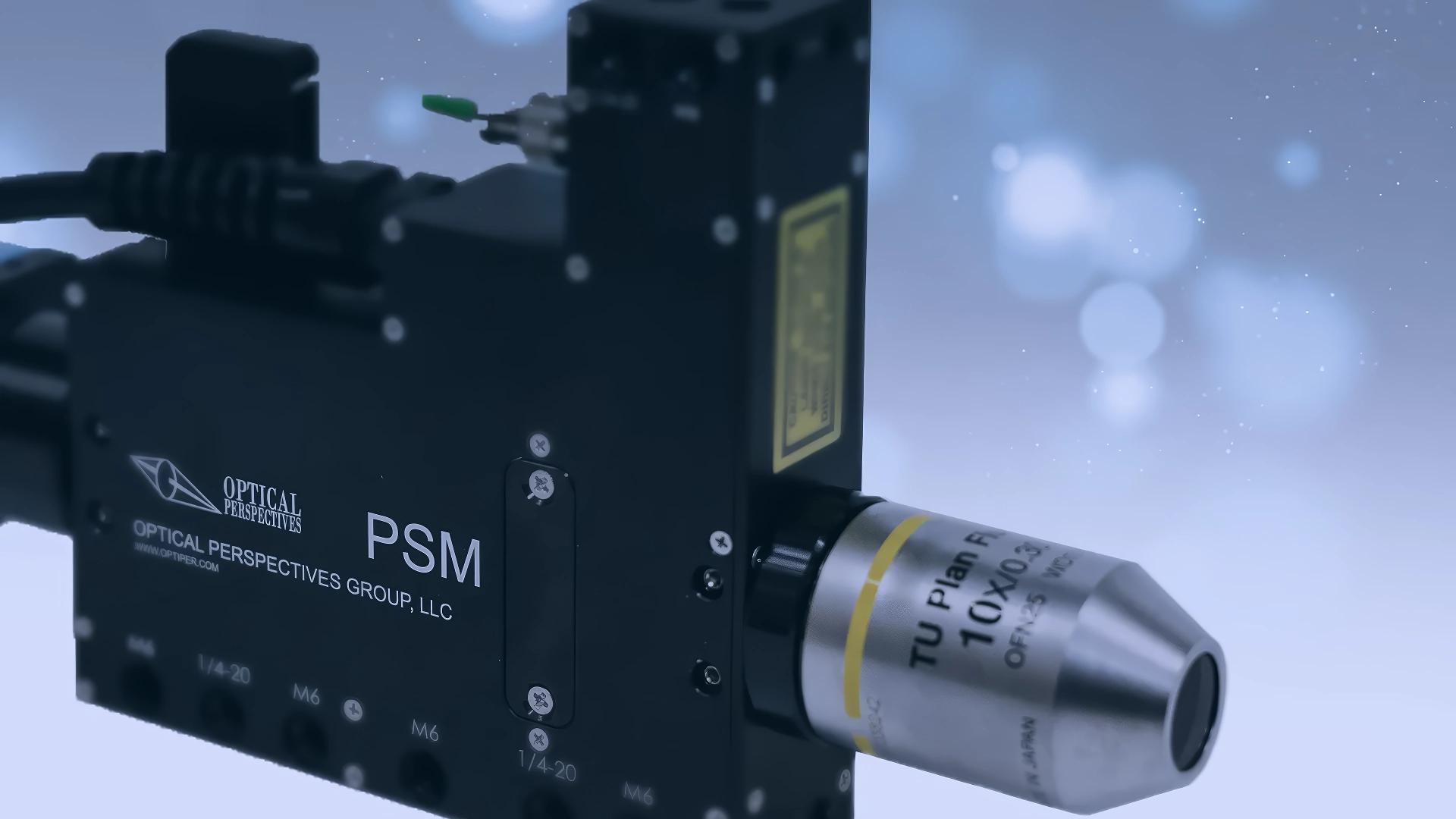
ROI Analysis: When to Invest in a Point Source Microscope for Your Lab
Capital equipment decisions demand rigorous financial justification. When precision optical alignment challenges consume your lab’s time and budget, determining whether a Point Source Microscope delivers adequate return on investment requires examining multiple cost factors, time savings, and performance improvements. At $23,950 for a complete system including Python-based PSM Align software, the Point Source Microscope represents […]
Complementary Aspects of Optical Alignment and Image Symmetry
INTRO: INTRODUCTION
Almost all optical elements and systems are sym- metric about their optical axes which means there are only 5 degrees of freedom that will affect op- tical alignment. Likewise, stigmatic images of a point source of light imaged by a finite conjugate optical system have 5 types of symmetry. There is a part of the image that is symmetric about the centroid of the image, and there are 4 symmetries in the plane of the image, namely, even-even, odd-odd, even-odd and odd-even. We show there is a one-to-one correspondence between the im- age symmetries and the degrees of freedom op- tical elements can be moved to align them.
Transmission sphere calibration using a Fresnel zone CGH
ABSTRACT: There are two basic methods of calibrating a transmission sphere without use of an external artifact, statistical or shear. In the low NA range where shearing is the preferred method, the calibration is difficult to perform precisely because it is hard to measure the shear distance or rotation of the reference surface precisely. If the reference is a Fresnel zone CGH, then there are two centers of curvature that provide an axis that can be located precisely. We show theoretically and experimentally an absolute method of calibrating a TS using one rotational and one translational shear.
PHYSICAL RAY TRACING WITH BESSEL BEAMS
Authors: Robert E. Parks (Optical Perspectives Group, LLC) and Daewook Kim (J. C. Wyant College of Optical Sciences, University of Arizona). INTRODUCTION Following the discovery of so called non-diffracting Bessel beams[1], they have been used for a number of exotic purposes such as trapping single atoms and aiding in the discovery of exoplanets. We discuss more […]
Prism Alignment Using A Point Source Microscope
The Point Source Microscope (PSM) is used to locate the apex of retroreflecting prisms in 3 degrees of translational freedom with a precision of less than 1 micron. The process is easily explained for right angle prisms, as will be done in this paper, but the explanation is valid for cube corner retroreflectors such as those mounted in spherical balls, spherically mounted retroreflectors, or SMRs, for use with laser trackers. With suitable, simple fixtures, the measurements for all 3 directions are made to a precision of < 1 μm in less than 1 minute.
Centering Steep Aspheric Surfaces
1. INTRODUCTION Finding the optical axis of an aspheric surface is an essential part of making an aspheric lens because the center of curvature, or optical axis, of the second side must lie on, or be coincident with, respectively, the optical axis of the first side for maximum optical performance. Looking at the center of […]