We recently began assembling a 10.6 µm interferometer using a CO₂ laser as the coherent light source. Because most CO₂ lasers are designed for materials processing, their output power is far greater than is practical—or safe—for interferometry. Even after inserting a wire-grid polarizer immediately after the laser, our initial alignment attempts resulted in a burned liquid-crystal card, minor damage to other components, and a slightly damaged camera.
It was clear that there had to be a safer and more efficient approach.
Although the wire-grid polarizer allowed us to reduce the laser power, we were constantly adjusting intensity—high enough to see the beam on the liquid-crystal card, but low enough to avoid destroying it. After roughly aligning most of the components and confirming that the critical elements worked, we paused to rethink the overall alignment strategy.
Since all components downstream of the wire grid polarizer were either reflective or ZnSe (which transmits both visible light and 10.6 µm), we decided to reverse the process and align the optics first using visible light, then align the CO₂ laser to the pre-aligned system.
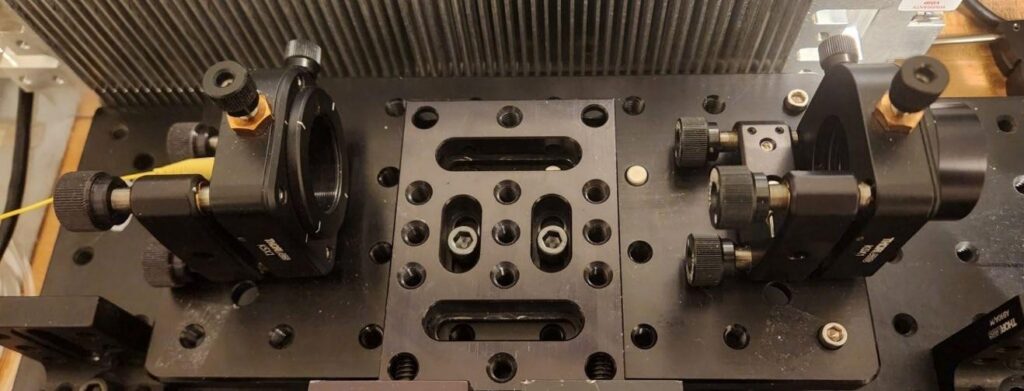
To do this, we built a simple Bessel-beam projector using off-the-shelf parts. The projector consisted of an adapter to accept a single-mode fiber as the source and a 1-inch lens holder containing an axicon grating. Both were mounted on a small breadboard plate positioned where the laser would ultimately be placed. A single-mode fiber provided the input on the left, while the axicon grating generated the Bessel beam to the right.
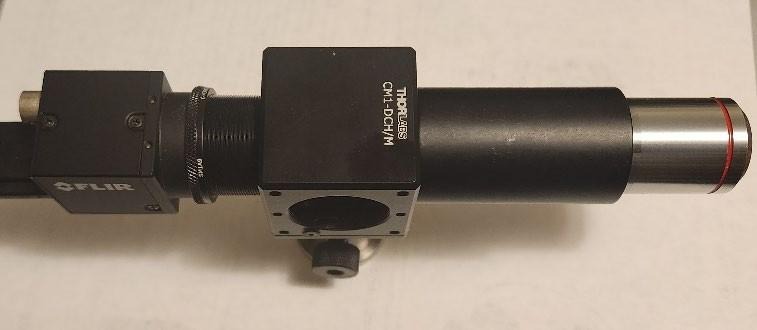
I used a small CCD camera as the detector, optionally paired with a low-power microscope objective. The setup also works without an objective, provided a short tube is left on the camera to prevent ambient light from flooding the sensor. A simple cube mount held the components together as in the picture. The shorter the tube length, the lower the magnification.
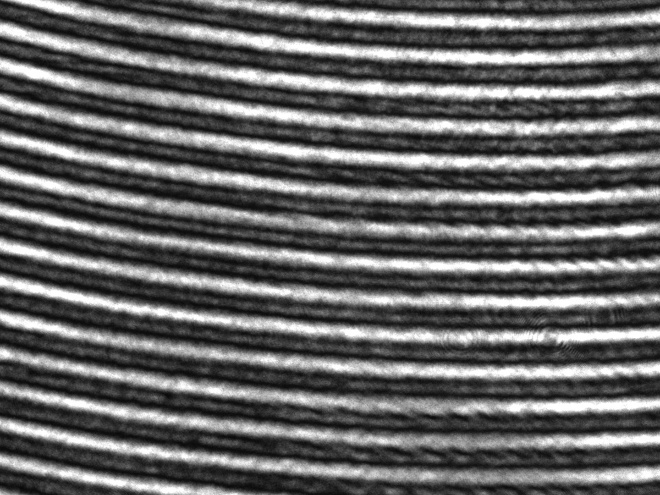
As I proceeded with the alignment, I saved several images as examples of what was seen by the detector. The picture on the left is an example of the Bessel beam misaligned by several mm. The rings show the direction to adjust the alignment to center the core of the Bessel beam on the camera.
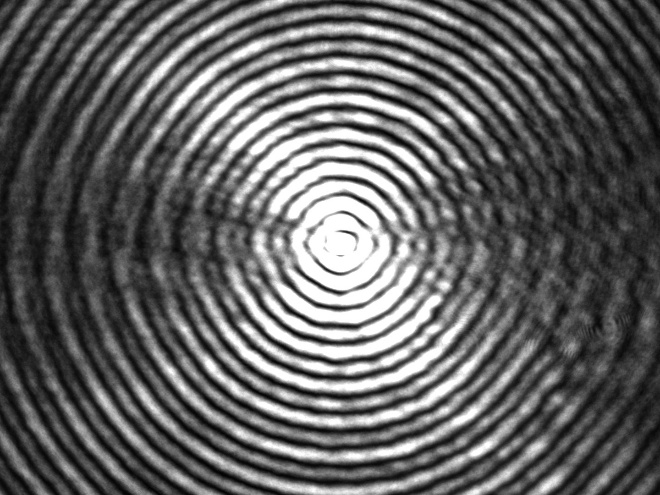
Once the beam is centered it looks like the picture on the right. The azimuthal variation in intensity is due to the beam being partially blocked upstream from where this image was taken by a scraper mirror. Despite a Bessel beam being “self-healing”, the intensity distribution depends on the geometry of where the beam was obstructed or what apertures were used before the beam gets to the detector.
Once the beam passed through a beam expanded in our setup it looked like this. All the Bessel beam photos were the full camera format of about 6.5 mm diagonal using the 5x infinite conjugate objective.
The alignment of the optics straight forward using the Bessel beam and a HeNe laser as the source for the single mode fiber. The fiber coupler on the laser provided a means of adjusting the source intensity by misaligning the input to the fiber.
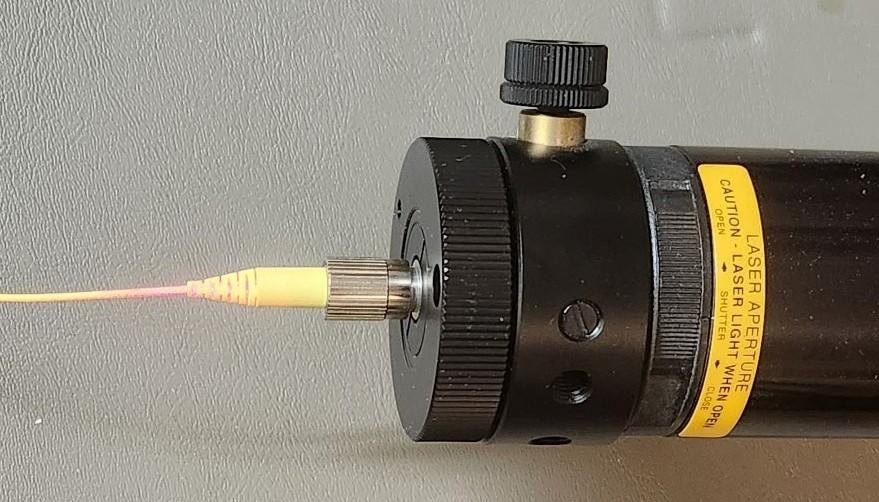
Once the beam got beyond the ZnSe beam expander and to the ZnSe beam splitter coated for use at 10.6 µm, the laser had insufficient intensity to view the beam on the camera. We switched to a cheap, battery operated fiber optics fault detector. It was sufficiently bright to finish the alignment.
Once both arms of the interferometer were aligned it was possible to go back to the HeNe laser and get dim, but good contrast visible light fringes on the camera due to the coherence of the laser. With the interferometer pre-aligned in the visible we were able to replace the Bessel beam projector with the CO₂ laser and use a bolometer to camera to see fringes from the moment we turned on the CO₂ laser.
To conclude, using a Bessel beam made our alignment much safer and simpler. Clearly this won’t work if there are elements in the system that do not transmit in the visible, but often there are groups of several mirrors that must be mutually aligned, and these can be done as a subset of the entire alignment in the visible. Even in the visible, the Bessel beam method with the simple camera and objective as a detector avoids possible eye injury because you can still see where the beam is going even though you have eye protection that blocks the real beam.