Since it’s Women’s History month, a question from my lawyer (a woman) about why Tucson is called “Optics Valley” reminded me of two influential women who are largely responsible for that legacy. The first is Lavinia Steward of Oracle, Arizona, who made the largest private donation to the University of Arizona up to that time in 1916 of $60,000 for a large telescope dedicated to the memory of her husband, Henry B. Steward. Mr. Steward was a mining engineer who consulted for and invested in mining companies in and around Arizona and had invested in property.
The donation funded the white brick building pictured below at its dedication in 1923 and a 36” reflecting telescope built under the direction of Andrew Ellicott Douglas who started the Astronomy Department at the University of Arizona in 1906. He is better known for starting the Tree Ring Lab because of his interest in sunspots and how they may have affected weather and thus the growth of trees.
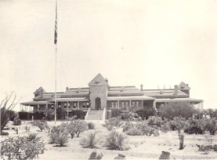
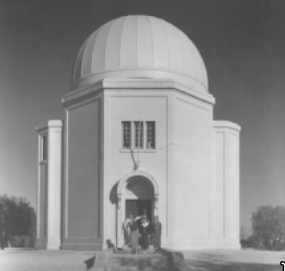
The Steward Observatory Building, which houses the 36” telescope, sits about a quarter mile from Old Main. At the time of its dedication, the landscape between the two buildings appeared much like the terrain shown above in the Old Main photo.
The other woman involved was Marjorie Pettit Meinel, the daughter of Edison and Hannah Steele Pettit, both astronomers. Marjorie was interested in following in their footsteps when she entered Pasadena Junior College on a college track curriculum. It was there she met Aden Meinel who had started on a trades track, and she convinced Aden to change to the college track and got him interested in astronomy. This led to Aden being accepted at Cal Tech while Marjorie began a BA at UC Berkeley. To make a long story short, the two got married shortly after Marjorie received a master’s degree in astronomy from Claremont College.
Shortly after that Aden was called up for duty in the US Navy and after his service, he used the GI Bill to get a Ph.D. in astronomy from UC Berkeley. Soon after, he got a job at Yerkes Observatory in Chicago, the place where Marjorie’s parents had done much of their work. Yerkes, like all the other observatories in
the US at that time, were privately funded institutions and these institutions decided on who got observing time on their telescopes. The US had no “national” observatory funded by the Federal Government that was open to any US astronomer who submitted a successful proposal for research. A committee was formed in about 1954 to propose a national observatory and find a site for it in the Continental US. Aden was chosen to head up the site survey for such an observatory.
After reviewing many sites and taking measurements on “seeing”, the effect of the atmosphere on the quality of images of stars, Aden and the committee settled on Kitt Peak, about 55 miles West of Tucson as the best site for the national observatory. The observatory would need a director to guide its building and administration, and Aden was chosen for this task. One of the first items of business was to set up an in town headquarters for the observatory and an optics shop to grind and polish the mirrors of the Mayall 2.1 m telescope for Kitt Peak. The headquarters were set up immediately across Cherry Ave. from the Steward Observatory.
By 1961, Kitt Peak was largely up and running. Aden was looking for an academic position so he could continue his work in astronomy rather than do administrative work. The University was looking to expand its astronomy department at the same time and offered Aden the directorship of Steward Observatory which he accepted.
During the time Aden was at Kitt Peak, the Russians launched Sputnik in 1957 starting the space race and a new page in the Cold War. Once it was possible to orbit the earth it was clear that missiles and telescopes could also orbit the earth. At that time there was only one place in the US that housed most of its optical knowledge outside of astronomy and that was Rochester, NY. As a matter of national security, it was decided it was unwise to have all the eggs in one basket.
Aden worked with others including the University president, Richard Harvill, to convince the Air Force to start an applied optics program at the University. It started as the Optical Sciences Center in 1964 that reported directly to the university vice-president for research under a grant from the Air Force with Aden as the first director. Aden remained as director until 1972 when he resigned so that he and Marjorie could devote their full time to work in astronomy and solar energy. They shared an office on the ground floor of the Optical Sciences building, now the J. C. Wyant College of Optical Sciences, until 1984 when they left the University to take a position at the Jet Propulsion Lab in Pasadena.
Tucson is Optics Valley because of the many graduates from the University that went on to start optics businesses in Tucson. Perhaps the most successful was Jim Wyant who started Wyko with Chris Koliopolis in 1984 and then after selling Wyko returned to the University to teach before investing in 4D Technology. Koliopolis also started his own companies Phase Shift Technology, Zemetrics and InterOptics. Tony Gleckler started GEOST in 2004 which was recently acquired by Rocket Lab. An early graduate of Optical Sciences was Robert Breault who founded Breault Research Organization in 1979 where Bob is still active in optics in Tucson. The list goes on as new graduates apply their learning to new fields in optics.
On a personal note, Aden was responsible for my coming to Tucson. My first job was at Eastman Kodak Company and the division I was in was intimately familiar with the work of Aden and Optical Sciences. We had the bright orange covered reports from the early days of Optical Sciences in our company library where they were often referred to. Because of my knowledge of the reputation of Optical Sciences, when I heard they were looking for someone to run the optical shop, I immediately applied for the job and was accepted in 1976. I have never regretted the move and the opportunities the job provided.
References: It is hard to cite specific references other than the book by Jim Breckinridge, an early graduate of Optical Sciences, and Alec Pridgeon about Aden and Marjorie called “With stars in their eyes”, Oxford University Press, 2022. Other than that I relied heavily on ChatGPT and Google Search for many of the names and dates. Any errors and omissions are entirely my own.